Category: Advocacy

  • (Updated)Offokaja Foundation Requests Kenya’s Support for Haiti’s Bid to Join The African Union

    (Updated)Offokaja Foundation Requests Kenya’s Support for Haiti’s Bid to Join The African Union

    Update: We are grateful to the Pan-Africanist Republic of Kenya and it’s listening, Pan-Africanist President, William Samoe Ruto for advocating for Haiti to be officially recognized by the AU as part of its 6th Region (all current AU Member States come from the AU’s five other regions). We are happy that following our advocacy in 2024, during the 2025 summit of the African Union Kenya’s State House Spokesperson Hussein Mohammed made this statement:

    President William Ruto proposes the adoption of a Draft Declaration on AU Solidarity with Haiti at the AU Assembly, to affirm its status as part of Africa’s Sixth Region…” Indeed, we watched President Ruto advocate for Haiti in his speech at the Summit, and Kenya’s draft resolution proposing this recognition was made available to us.

    In that Draft Declaration, Kenya noted that;

    “CONTEXT:

    1.The African Union Assembly vide its decision 884 of February, 2024 affirmed the deep-rooted Pan African origins of the African Union and those of its precursor, the Organisation of African Unity, encompassing historical, cultural and blood ties that bind the continent of Africa and the African Diaspora.

    2. Further More, the African Union Assembly adopted vide its decision 884 of February, 2024 the theme of the year for 2025 as “Justice for Africans and People of African Descent Through Reparations’’. In line with this theme the AUC has committed itself to pursue justice and reparation for acts perpetuated by colonial masters on African States and invariably on African Diaspora and People of African descent.

    3. The Member States of the African Union in adopting the Constitutive Act, affirmed, inter alia, their inspiration by the noble ideals which guided the founding fathers of our Continental Organization and generations of Pan-Africanists in their determination to promote unity, solidarity, cohesion and cooperation among the peoples of Africa and African States.

    4. The Assembly of Heads of State and Government of the African Union at its 32nd Ordinary Session in February, 2019 adopted a Declaration on the AU Recognition of the400th Anniversary of the Transatlantic Slave Trade Assembly/AU/Decl.2(XXXII). In the Declaration, the Assembly, inter alia:

    i. Reaffirmed our commitment to the Unity of African People, to building an integrated Africa, to forging cultural, political, social and economic linkages that further the Pan Africanist dream among all peoples of African descent;

    ii. Urged all Member States of the Union to consider immigration, economic,cultural and social policies that allow the Africans descended from the victims and survivors of the transatlantic Slave Trade to reconnect and reengage with their brethren in the African Continent;

    5. Agenda 2063 has been adopted by Member Sates of the African Union as Africa’sblueprint and master plan for transforming Africa into the global powerhouse of the future.Aspiration number two (2) of Agenda 2063 speaks to ‘‘An integrated continent, politicallyunited, based on the ideals of Pan-Africanism and the vision of Africa’s Renaissance’’.Africa commits to have dynamic and mutually beneficial links with her Diaspora.

    This advocacy by Kenya is significant because it’s the first time an African Union Member State is specifically advocating for the closer integration of Haiti into the African Union at an AU Assembly since the unfortunate freezing of Haiti’s bid in 2016. And it serves as a beacon of hope to other countries of the African Diaspora/6th Region of the African Continent who might wish to join the AU in future.

    And so, we express the hope that this movement by Kenya becomes the beginning of a wellspring of overwhelming support that would lead to membership of willing States of the African Diaspora/AU Sixth Region on a basis of equality with AU Member States from the other 5 Regions.

    The Prince and Princess Charles Offokaja Foundation International on the 5th of September, 2024, the Pan Africanist think-and-do tank, wrote to Kenya’s President, William Samoe Ruto, urging that Kenya advocates support for Haiti’s (currently stalled) 2016 bid to join the African Union (AU) at the African Union Assembly.

    “We are confident of your interest in helping out Haiti, the first free Black Republic, and a Brother country to your country in its time of great need. And we implore you not to hesitate from this noble action that would make Mother Africa proud, even if at first, you stand alone.

    The letter reads, “Dear President William Samoei Ruto CGH,

    “We hope this letter finds you in good health and spirits. I am writing to you on behalf of the Prince and Princess Charles Offokaja Foundation, an organization committed to the Membership of willing States of the African Diaspora in the African Union, AU.

    “We are deeply concerned about the refusal of the African Union (AU) Commission to transmit Haiti’s 2016 application to join the AU. We are disturbed about the socioeconomic and sociocultural impact it is having on Haitians, and citizens of AU Member States.

    “This refusal has prevented the potential expansion of the African Continental Free Trade Area, AfCFTA to include willing States in the African Diaspora.
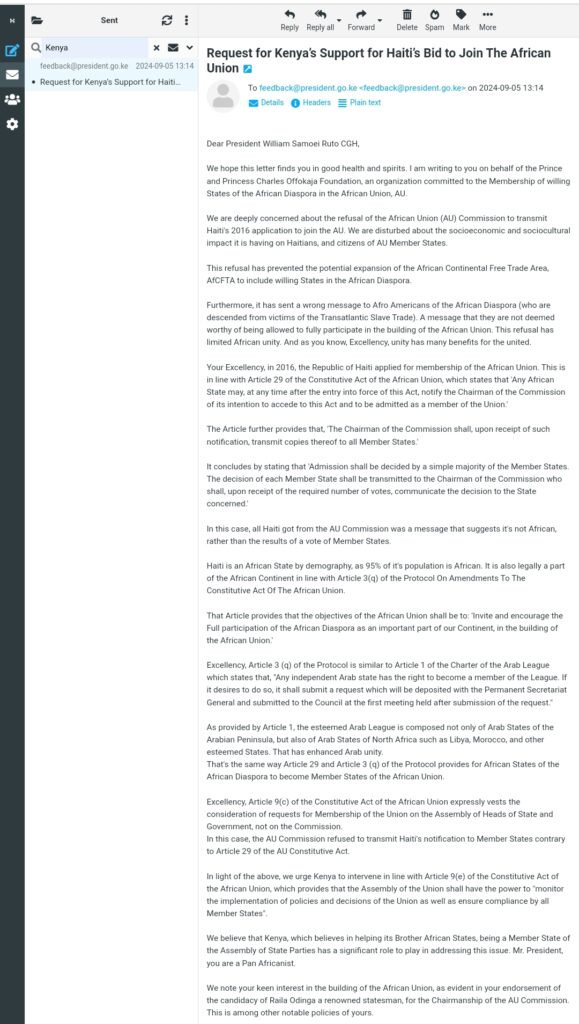
    “Furthermore, it has sent a wrong message to Afro Americans of the African Diaspora (who are descended from victims of the Transatlantic Slave Trade). A message that they are not deemed worthy of being allowed to fully participate in the building of the African Union. This refusal has limited African unity. And as you know, Excellency, unity has many benefits for the united.

    “Your Excellency, in 2016, the Republic of Haiti applied for membership of the African Union. This is in line with Article 29 of the Constitutive Act of the African Union, which states that ‘Any African State may, at any time after the entry into force of this Act, notify the Chairman of the Commission of its intention to accede to this Act and to be admitted as a member of the Union.’

    “The Article further provides that, ‘The Chairman of the Commission shall, upon receipt of such notification, transmit copies thereof to all Member States.’

    “It concludes by stating that ‘Admission shall be decided by a simple majority of the Member States. The decision of each Member State shall be transmitted to the Chairman of the Commission who shall, upon receipt of the required number of votes, communicate the decision to the State concerned.’

    “In this case, all Haiti got from the AU Commission was a message that suggests it’s not African, rather than the results of a vote of Member States.

    “Haiti is an African State by demography, as 95% of it’s population is African. It is also legally a part of the African Continent in line with Article 3(q) of the Protocol On Amendments To The Constitutive Act Of The African Union.

    “That Article provides that the objectives of the African Union shall be to: ‘Invite and encourage the Full participation of the African Diaspora as an important part of our Continent, in the building of the African Union.’
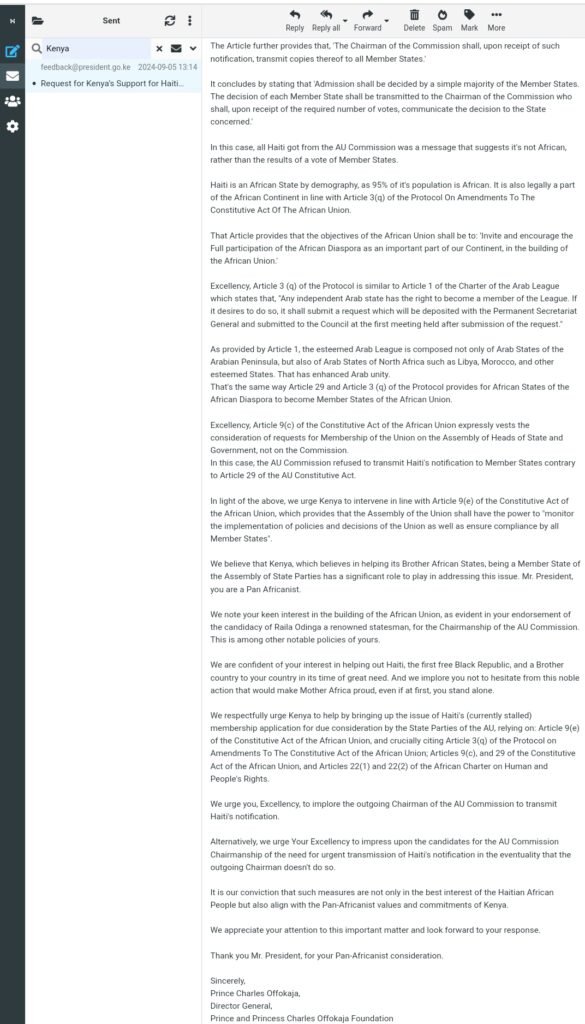
    “Excellency, Article 3 (q) of the Protocol is similar to Article 1 of the Charter of the Arab League which states that, “Any independent Arab state has the right to become a member of the League. If it desires to do so, it shall submit a request which will be deposited with the Permanent Secretariat General and submitted to the Council at the first meeting held after submission of the request.”

    “As provided by Article 1, the esteemed Arab League is composed not only of Arab States of the Arabian Peninsula, but also of Arab States of North Africa such as Libya, Morocco, and other esteemed States. That has enhanced Arab unity.
    That’s the same way Article 29 and Article 3 (q) of the Protocol provides for African States of the African Diaspora to become Member States of the African Union.

    “Excellency, Article 9(c) of the Constitutive Act of the African Union expressly vests the consideration of requests for Membership of the Union on the Assembly of Heads of State and Government, not on the Commission.
    In this case, the AU Commission refused to transmit Haiti’s notification to Member States contrary to Article 29 of the AU Constitutive Act.

    “In light of the above, we urge Kenya to intervene in line with Article 9(e) of the Constitutive Act of the African Union, which provides that the Assembly of the Union shall have the power to “monitor the implementation of policies and decisions of the Union as well as ensure compliance by all Member States”.

    “We believe that Kenya, which believes in helping its Brother African States, being a Member State of the Assembly of State Parties has a significant role to play in addressing this issue. Mr. President, you are a Pan Africanist.

    “We note your keen interest in the building of the African Union, as evident in your endorsement of the candidacy of Raila Odinga a renowned statesman, for the Chairmanship of the AU Commission. This is among other notable policies of yours.

    “We are confident of your interest in helping out Haiti, the first free Black Republic, and a Brother country to your country in its time of great need. And we implore you not to hesitate from this noble action that would make Mother Africa proud, even if at first, you stand alone.

    “We respectfully urge Kenya to help by bringing up the issue of Haiti’s (currently stalled) membership application for due consideration by the State Parties of the AU, relying on: Article 9(e) of the Constitutive Act of the African Union, and crucially citing Article 3(q) of the Protocol on Amendments To The Constitutive Act of the African Union; Articles 9(c), and 29 of the Constitutive Act of the African Union, and Articles 22(1) and 22(2) of the African Charter on Human and People’s Rights.

    “We urge you, Excellency, to implore the outgoing Chairman of the AU Commission to transmit Haiti’s notification.

    “Alternatively, we urge Your Excellency to impress upon the candidates for the AU Commission Chairmanship of the need for urgent transmission of Haiti’s notification in the eventuality that the outgoing Chairman doesn’t do so.

    “It is our conviction that such measures are not only in the best interest of the Haitian African People but also align with the Pan-Africanist values and commitments of Kenya.

    “We appreciate your attention to this important matter and look forward to your response.

    “Thank you Mr. President, for your Pan-Africanist consideration.

    Sincerely,
    Prince Charles Offokaja,
    Director General,
    Prince and Princess Charles Offokaja Foundation

  • Open Letter to H.E. Moussa Faki Mahamat, Chairman of the African Union Commission #Justice4Haiti

    Open Letter to H.E. Moussa Faki Mahamat, Chairman of the African Union Commission #Justice4Haiti

    Dear Chairman Moussa Faki Mahamat,

    We, respectfully request that you send Haiti’s 2016 notification for membership in the African Union (AU) to all AU Member States for their review and decision.

    Haiti, known as the world’s first free black republic, informed the AU of its intention to join the Union in 2016, based on Article 29 of the Constitutive Act of the African Union. According to this article, admission should be determined by a simple majority vote among AU Member States. However, the AU Commission decided not to admit Haiti, citing that “only African countries can join the AU,” implying that Haiti is not considered an African country.

    We contest this decision. While Haiti is not geographically on the African continent, AU law recognizes it as legally part of the African Continent. This is supported by Article 3(q) of the Protocol on the Amendments to the Constitutive Act of the African Union. Furthermore, approximately 95% of Haitians are descendants of Africans who were enslaved and forcibly brought to the Caribbean, creating a substantial historical and cultural connection.

    Had Haiti’s membership notification been forwarded and accepted by a simple majority, Haiti would have had the opportunity to join the African Continental Free Trade Area (AfCFTA), benefiting both its development and Africa’s economic integration.

    We urge you to follow the example set by the General Secretariat of the Arab League, which has not allowed geography to limit its adherence to Article 1 of the Charter of the League of Arab States. This has allowed several North African countries to be full members of the Arab League despite not being part of the Arabian Peninsula. Additionally, the United States provides a relevant example: despite not being part of the continental U.S., Hawaii enjoys full rights as a state, as proven by Barack Obama’s presidency.

    Excellency, we earnestly implore you to transmit Haiti’s membership notification to all AU Member States for their decision. Doing so will reaffirm the AU’s commitment to justice, equality, and international solidarity.

    Sincerely,

    The Prince & Princess Charles Offokaja Foundation
    Supporters of #JusticeForHaiti

  • Report On Universal Jurisdiction Of The International Criminal Court

    Universal Jurisdiction of the International Criminal Court: An Insightful Report

    Introduction

    The International Criminal Court (ICC), established by the Rome Statute in 1998, is an intergovernmental organization and international tribunal seated in The Hague, Netherlands. Unlike traditional criminal jurisdictions limited by territorial or national parameters, the ICC embodies a broader legal doctrine: universal jurisdiction. This principle asserts that certain crimes are so heinous that they represent offenses against all of humanity and can therefore be prosecuted by any court, regardless of where the crime was committed or the nationality of the perpetrators or victims.

    The ICC’s Jurisdiction

    The ICC’s jurisdiction is principally based on:

    • Territoriality: Crimes committed within the territory of a State Party.
    • Nationality: Crimes committed by nationals of a State Party.
    • Referral by the United Nations Security Council (UNSC): Under Chapter VII of the UN Charter.
    • Acceptance by a non-party state: A state not party to the Rome Statute may accept the jurisdiction of the ICC on an ad hoc basis.

    The Crimes

    Universal jurisdiction through the ICC can be applied to four core international crimes:

    1. Genocide: Acts with intent to destroy, in whole or in part, a national, ethnical, racial, or religious group.
    2. Crimes Against Humanity: Widespread or systematic attacks directed against civilians, including murder, enslavement, torture, and rape.
    3. War Crimes: Grave breaches of the Geneva Conventions, such as willful killing and extensive destruction of property.
    4. Crime of Aggression: The planning, preparation, initiation, or execution of an act of using armed force by a state against the sovereignty, territorial integrity, or political independence of another state.

    Limitations and Challenges

    While the ICC is a groundbreaking step towards enforcing international law, it faces limitations and challenges:

    • State Sovereignty: The principle of universal jurisdiction can clash with the concept of state sovereignty.
    • Political Will: The ICC relies on the cooperation of states for arrest and surrender of suspects, which can be influenced by political interests.
    • Selective Jurisdiction: The requirement of UNSC referral for non-State Parties can lead to selective enforcement.
    • Resource Constraints: Limited resources can impede the ability of the ICC to pursue all cases falling under its jurisdiction.

    Conclusion

    The ICC’s incorporation of the universal jurisdiction principle signifies an evolution in holding perpetrators of the most serious crimes accountable. With appropriate support from the international community, the ICC could strengthen its role in the pursuit of global justice. However, the court’s full potential depends on overcoming the attendant challenges, especially relating to state cooperation and political influence. As global attitudes towards sovereignty and jurisdiction evolve, so too may the efficacy and reach of the International Criminal Court.

  • Administrative Remedies For Unfair Electricity Disconnection

    It pains Nigerians when they look around the other houses in there neighborhood and see that only them do not have electricity supply. E dey pain eh!

    But that is sometimes the reality. And sometimes this is because the electricity distribution company (disco) abruptly cut their electricity supply, sometimes without even informing the consumer.

    According to consumer protection regulations the disco is supposed to provide reliable electricity for consumers and tell them before disconnecting their electricity supply.

    Sometimes Nigerian consumers may decide to see a lawyer but may back down if the cost of taking the case to court is too much. We have also heard or seen stories of Nigerian consumers who take the law into their own hands and thus get on the wrong side of the law.

    But the National Electricity Regulation Commission NERC has provided a cheaper and legal way that may be used to pursue such issues without breaking the bank or committing an offence that could lead to arrest and prosecution. That is what we will talk about today.

    Please note the information provided in this article is general in nature and should not be considered a substitute for personalized legal advice.

    If an electricity consumer feels their electricity supply has been unfairly disconnected, they can send an email of their complaint to their disco
    including in that email details about the alleged unfair disconnection such as meter number, and phone number to facilitate communication in resolving the issue.

    The consumer can get the official customer complaint email address and phone numbers of their electricity distribution company from this resource article provided by NERC. When on the page they can click on their own disco to get it’s contact details.

    Contact through the disco’s email address can help the consumer document the process in case it is needed for future reference.

    The serial number in the disco’s response email can be useful for tracking the complaint through phone calls. So, the consumer should consider writing it out.

    The general rule in this kind of complaint is to give the disco a chance of one month to see if they’ll rectify the issue complained about.

    If the electricity consumer’s concerns aren’t addressed within a month, he/she may consider escalating the matter to NERC itself by writing a complaint to NERC and attaching a copy of the complaint earlier sent to the disco.

    NERC has binding powers over the discos, and can enforce corrections if the consumer has truly faced unjust disconnection. NERC has various appeal stages if the consumer is dissatisfied.

    It is hoped that along the route from complaining to the disco to the various escalation steps the consumer gets effective remedy.

  • Human Rights: Spiking Medicine Costs Should Be Struck Down

    Human Rights: Spiking Medicine Costs Should Be Struck Down

    The right to health is a very essential human right. When the right to health is realized, other rights can easily be realized.

    Apart from food and water, one of the most important things to have is medicine. Food and water can sustain a healthy body. Medicine can nurse an unhealthy body back to health.

    The Universal Declaration of Human Rights provides in Article that, “

    (1) Everyone has the right to a standard
    of living adequate for the health and
    wellbeing of himself and of his family,
    including… medical care and necessary social services, and the right to security in
    the event of … sickness, disability, widowhood, old age or other
    lack of livelihood in circumstances
    beyond his control.”

    There is no way to have health if medical care is too expensive and government doesn’t do anything to restore the health security of it’s citizens so they can afford adequate medical care including medicines.

    Before now Nigeria was already grappling with the japa syndrome where Nigerian doctors have been lured out of the country in very large numbers. Many doctors simply got fed up with the situation in the country. Now, there is a dent in the availability of doctors in Nigeria.

    Pharmaceutical Japa

    It now seems that a new issue is cropping up. The creeping rise of medicine cost beyond the reach of the average Nigerian. This is mainly because pharmaceutical companies have been packing up and leaving the country.

    The other day, we wrote about the sudden high rise in the cost of inhalers for asthma. Inhalers like Seretide. Then just a few days ago, social media became awash with reports that the general price of Augmentin antibiotics has spiked from about N7000 to about N57000.

    This is not good. Apart from hunger, another malady that must be avoided for the citizenry is illness without the ability to buy medication. Hunger can become very dangerous if one doesn’t eat in a few weeks. In the same way, many illnesses can become extremely harmful if a sick person doesn’t get treated on time. Sometimes such illnesses require urgent attention to nurse the patient back to health.

    Nigerians have faced a lot since the recession of 2015. The government has an obligation to fulfill the right to health of Nigerians.

    The government should bring down the rising prices of medicines through introduction of subsidies and effective engagement with pharmaceutical companies to invcentivise them to stay on in Nigeria.